April 2026 Feature: Malika Booker
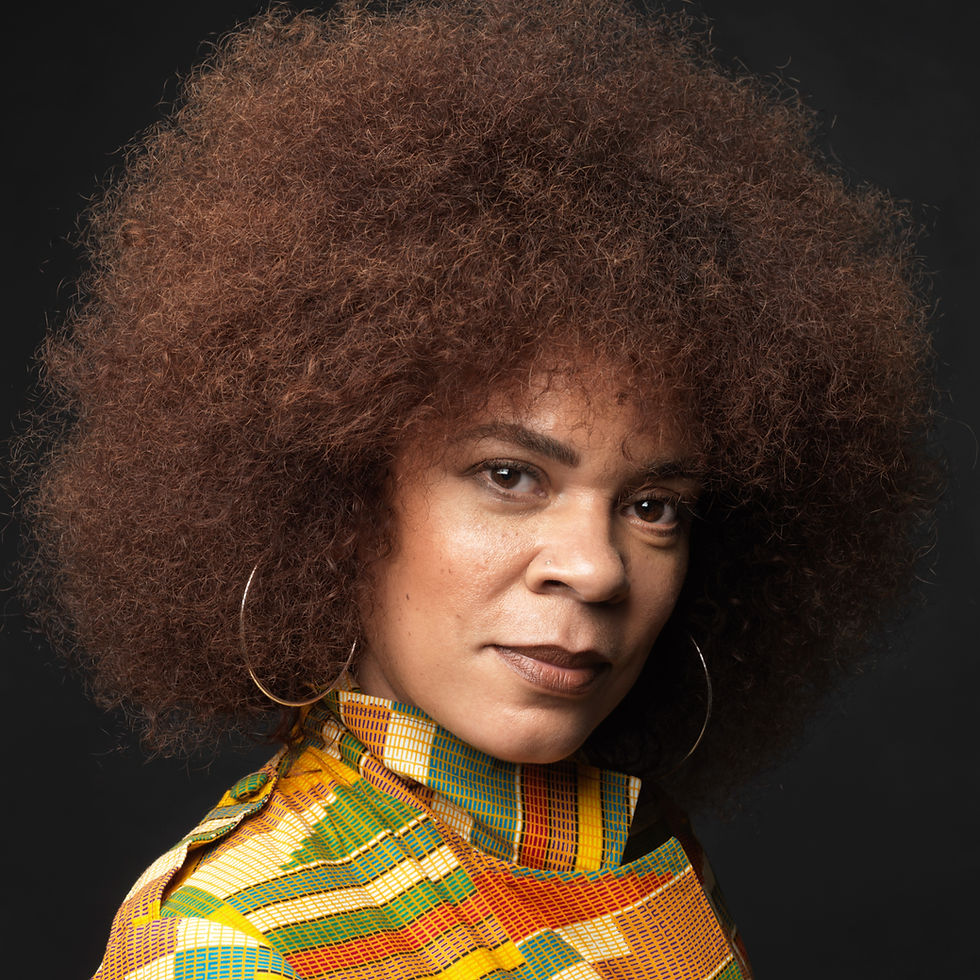
Dr. Malika Booker is a UK-based British-Caribbean poet and the award-winning author of Breadfruit and Pepper Seed.

Malika Booker is a lecturer at Manchester Metropolitan University, a British poet of Guyanese and Grenadian Parentage, and co-founder of Malika’s Poetry Kitchen (A writer’s collective). The Anthology - Two Young, Two Black, Too Different, Poems from Malika’s Poetry Kitchen was recently published to celebrate Malika Poetry Kitchen’s twentieth anniversary. Her pamphlet Breadfruit, (flippedeye, 2007) received a Poetry Society recommendation, and her poetry collection Pepper Seed (Peepal Tree Press, 2013) was shortlisted for the OCM Bocas prize and the Seamus Heaney Centre 2014 prize for first full collection. She is published with the Poets Sharon Olds and Warsan Shire in The Penguin Modern Poet Series 3: Your Family: Your Body (2017). Booker and Shara McCallum recently co-edited the issue of Stand Journal, curating an anthology of poems by African American, Black British, & Caribbean Women & Identifying Writers. Booker currently hosts and curates Peepal Tree Press’s Literary podcast, New Caribbean Voices. A Cave Canem Fellow, and inaugural Poet in Residence at The Royal Shakespeare Company, Malika was awarded the Cholmondeley Award (2019) for outstanding contribution to poetry and elected a Royal Society of Literature Fellow (2022). Her poem The Little Miracles, commissioned by and published in Magma 75(autumn 2019), won The Forward Prize for Best Single Poem (2020). Her poem Libation, published in Poetry Review (winter 2022) won The Forward Prize for Best Single Poem (2023).
Jonah at the Border
Did not Jonah seek to hide on a ship? Hide esp. take cover
so as not to be seen or found. 2. Lay low as in secrete, huddle
up, knee to chin, palms cradling the underside of gut, while
the poor boat bobbles like dumplings bubbling up in soup. All
how he turn is vomit he want vomit in all the bangarang.
How he start reason with he-self like prophet. How he start
wonder is when rasta man like he end up crump up down here?
•••
Jonah meaning Dove.
meaning sailor or
meaning person on board ship bringing bad luck.
meaning a person jinx…¹
•••
But when they persecute you in this city flee to the next: for verily I say unto you²
•••
I read a book once 'Feel the Fear and do it anyway'³
The author Susan Jeffers made it sound so easy
twelve years later I still cannot jump into water (swimming pools
or the ocean) for fear of water invading my eyes.
•••
But Jonah rose up to flee unto Tarnish from the presence…
•••
Man every passage is a risk, see how emptiness erupts
pon we tongue, sandpaper gently scraping we dark
skin, that’s how you know is bad, when grated skin
comforts more than what we left behind. You aint see
the way news reports full up with our perilous
crossings, more comforting than land left behind.
The way we get painted as crowds of cockroaches
skittering over wooden floorboards. Steups!
And you blind worms can’t see we as paper
dissolving in water, vanishing bodies. These days
when we get flung overboard no whale swallows
us whole to resurrect us on the third day.
•••
But the LORD sent out a great wind into the sea,
and there was a mighty tempest in the sea, so the ship was like to be broken.
Then the mariners were afraid, and cried every man unto his god, and cast
forth the wares that were in the ship, to lighten it of them.⁴
•••
As I write this poem I remember a Guyanese folksong we sung
in school: Itaname about how hard it is to navigate
the treacherous waters especially the jungle rapids.
Captain, captain, put me ashore!
I don’t want to do anymore.
Itaname too much for me!
Itaname gun friken me!
Itaname, Itaname!
Itaname! Itaname!
•••
Today the News headline reads: Horrifying new detail on death of “Jamaican men in wheel wall of the JetBlue plane: Men found in the landing gear. As I read I consider the biblical line:⁵but the Dove found no rest for the sole of her feet
so it start climb in then crump up inna the wheel wall
and so he lay coumblé trembling body beating against the wheel wall
humming if I had the wings of a Dove ⁶ till lips too heavy inna the wheel wall
till body start lick up itself pon wall like stick pon drum inna the wheel wall
lying crump up crump up black skin resting on white metal inna the wheel wall
singing this is what it sounds like when doves cry ⁷ till fingers & toes start tingle inna
the wheel wall
scared so till he could not hear the sound of his own heartbeat inna the wheel wall
the sole of his feet turn ice fingers turn ice ears turn ice inna the wheel wall
who will put forth his hand and ⁸ pluck him from this flight as he flees inna the wheel wall
till he head start get bazodee, when the plane start rise higher inna the wheel wall
thinking I’ll fly away oh glory I’ll fly away ⁹ right now from inna this wheel wall
till he belly start talk in a strange tongue to turbulence bass inna the wheel wall
till he start reason call out Jesus call out God call out ‘À mwè’ inna the wheel wall
how he could not even take flight when ice start cover him like coffin blanket inna the wheel wall
•••
Then the questions begin:
Tell us, we pray thee, for whose cause this evil is upon us; What is thine occupation?
And whence comest thou? What is thy country? And of what people art thou? ¹⁰
•••
For in your poetic vision, a boat had no belly, a boat does not swallow up, a boat does not devour, a boat is steered in open skies. Yet the belly of this boat dissolves you precipitates you into a nonworld from which you cry out. The boat is a womb, a womb abyss.¹¹
•••
Then they said unto him, What shall we do unto thee
that the sea may be calm unto us? For the sea wrought and was tempestuous.
And he said unto them, Take me up, and cast me forth into the sea;
•••
My aunt tells me in those days they taught you to swim like Bad John:
she in that fishing boat, she father belly high beyond pregnant
she brothers grinning in khaki short pants, how they palms circled
she wrists and ankles. How they stretch she out like rope, swing
she round and round then dash she in the water. That is how
they use to teach you to swim in them days. Sink or swim girl
they start shout after they just throw she out like garbage. How
she just make one big splash then start sink, how she never
fight when water start blind and deaf she tail, till she father
had to jump in, haul she out, flip she over then thump she
back, till the entire sea spill out she mouth and nose.
Till she scared water bad bad to this unholy day.
•••
The waters compressed me about, even to the soul; the depth closed me
about, the weeds were wrapped about my head ¹²
•••
It was the day to behead the chickens. The chicks I fed
scattering grain in they brown cardboard box home. Cooing
to them. Stroking they yellow. Then just so dry, they turn full
blown and cranky, only pecking ankles, when ah collecting
eggs in the coop. It is the day to behead
the chickens. Watch how sun smiling pon concrete like
is an ordinary day. Watch how birds peck the ripe soursop
on we little tree. Father sharpening, he cutlass. While I beg
for them. Meh little brothers catch and clench the top
of their wings in one hand. Father stoops into position.
He places the first offering between he feet. Stands on
them wings. I flee. If you see how fast, I tear up
the wooden backstairs. Then slide under meh bed. Silent.
Meh heart a beating speaker. Fingers shaking, lying
under meh bed reading Nancy Drew. All how ah turn I
can’t help think - Is what does summon the legs? What
or who decides the direction of our blasted feet? Figure
out how I reach under meh bed before even meh brain
decide to run. Downstairs in the yard, decapitated friends
flap clumsily into they deaths, with no brain to direct them,
how long do they flap before the body knows it no longer
has a brain, before the body is beyond their fear?
1 Adapted from Online Etymology Dictionary https://www.etymonline.com/word/Jonah
2 (Matthew 10: 23 Kings James Bible (KJV)
3 Jeffers, Susan. J. (1987). Feel the Fear and do it anyway.' Fawcett Columbine
4 Jonah 1:3-5 KJV
5 Daily Mail News Article. 7 th January 2025 US Reporter Joe Hutchinson
6 Hymn lyrics taken from Psalm 55:6 sag by Bob Marley and the Wailers. Also a popular funeral song
in the Caribbean Community
7 When Doves Cry – Prince and the Revolution (song) 1894.
8 Genesis 8:9
9 I’ll Fly away – Albert e. Brumley (hymn) 1932 often song at Caribbean funerals
10 Jonah 1:8
11 Glissant, Edouard, 1928-2011. Poetics of Relation. Ann Harbor: University of Michigan Press,
1987. P.5
12 Jonah 2:5
THE INTERVIEW
This interview was conducted between Malika Booker and Jae Nichelle on March 18, 2026.
Malika Booker Interview Questions
Wow, thank you for sharing this poem. You so skillfully weave in this re-imagined story of Jonah with present, personal, and historical moments of migration—all tied together by violence in and around water. What led you to begin with Jonah?
This is a great question. My current poetry project creolizes the Kings James Bible, by recasting the characters, locations and language of the KJV within the English-speaking Caribbean and its diaspora. This epic ekphrasis project enables Black bodies to enact embodied critiques of the enduring impact of plantocracy, colonialism and patriarchy on their lives. So, I lyrically reimagine characters like the Virgin Mary telling her mother she is pregnant and it is not Joseph’s child; or Jesus vulnerable in the Garden of Gethsemane wanting to enact a nine night wake the night before he is betrayed. Mrs. Noah and Samson’s mother interrogate how the act of non-naming diminishes their worth. This reimagined story of Jonah is part of this body of work.
Jonah enables me to cast a critical lens on migration globally and its impact on the people undertaking these perilous endeavors. The poem’s lyrical hybrid sequential form allows a micro and macro investigation and demonstration of the complexity of migration and its harrowing impact on the body. Here I can allude to the danger of Jonah’s journey, his disdain scorn and superciliousness towards people who were other and his reluctance to travel, as a metaphorical trope.
It also allows me to explore the western myths about Black people’s relationship to water hinting at the middle passage, while simultaneously alluding to the crossings and deaths that occur every day off the European coasts.
Fear is a throughline in this poem. What is your relationship with fear, especially when it comes up in your work?
The Black body must constantly navigate some element of fear, particularly in the diaspora. This fear (embedded in the white psyche) is responsible for the disproportionately high numbers of deaths in police custody and is an underlying current in our engagement with white society. These elements of fear began the moment we were kidnapped from the continent and continued through the middle passage, and on the plantation economy where our labour was extracted through barbaric measures and continues to present day. So, the Jonah poem enables an interrogation of multiple examples of these fears.
Personally, I remember my heightened fear living through Covid with the knowledge that in Britain a disproportionate number of Black people were dying, and that yet again my body was a vulnerable thing. It is this I suppose that has led me to my poetic preoccupation with examining the way we navigate our present lives in the shadow of fear. I hope that the Jonah poem alongside other poems enable us to scrutinize our fears, bravery and a sense of adventure in the face of adversity.
In the final stanza, the speaker instinctively runs for cover under the bed and grabs a book for comfort. It reminded me of a moment in your 2023 interview with Lauren K. Alleyne when you said you would read under your bed as a child, which opened up the worlds that would later enable you to write. Does being a writer feel like a choice you’ve made or an instinct, something inevitable?
I am more of a reader than a writer, who enjoys the act of reading for the worlds I discover and the knowledge I gain. Reading had a profound impact on my life at a crucial stage of my development. As an eleven-year-old, I moved from Guyana to Britain in 1981 and was severely lonely and bullied in the school yard. So much so that I asked the librarian if I could reshelve the books during the break and read to escape the bullies and the cold weather. I would borrow twelve books a week from the local library. Imagine my joy to discover ‘Ruby’ by Rosa Guy about a young West Indian teenager who had just migrated with her family to Harlem and was experiencing the same sense of alienation and bullying as me.
Anyway, I was an avid reader, yet most books I read were filled with white characters residing in worlds alien to my upbringing. I wanted to read about Caribbean women like my mother and aunts. I wanted books and poems to explore and reflect the vibrant, complicated characters from my community. I remember discovering Toni Morrison and Alice Walker and just knowing that I wanted to emulate what these women were doing with African American characters with Caribbean ones. I could think of nothing else I wanted to do but write. This is my vocation, my compulsion, a practice as necessary to me as breathing.
In that vein, I was so moved by this letter you wrote to your younger self, where you said writing is “a lifelong vocation and your development hinges on all of the sacrifices it requires.” What have been some of these sacrifices for you?
Everyone wants to please their family. Imagine living with being a family disappointment for years. Mothers, aunts and uncles shaking their heads at this young woman who is wasting her life on this weird dream and squandering her potential. Why could she not aspire to be a good lawyer like so and so’s child? A writer was not the average aspiration for a child of Caribbean immigrants. My mother enjoyed reading Pepper Seed and was proud of it, yet she would still sometimes say “it’s a pity you did not become a lawyer.”
When I decided to work in the arts and be a writer, I remember taking a job working in a poetry organization three days a week. I was the Poetry Educational Coordinator – placing poets into educational settings like schools and colleges to teach workshops and the pay was abysmal. On the other two days I worked freelance: conducting workshops in schools, doing arts commissions, and poetry performances. This work was sporadic; the organizations and schools would take a long time to pay me, and I would spend a considerable amount of my pay on writing courses, so I was often broke, juggling my bills, armed with this seemingly impossible dream of working in the arts and being a writer, while investing in my writer development. I spent over fifteen years attending evening courses, retreats, and residentials committed to learning craft and becoming a better writer.
There was also a rigid determination, as demonstrated by my steadfast commitment to being accepted to Cave Canem. I spent years applying – even though I had never seen a Black British Writer attend Cave Canem before and had no idea if they would accept international writers like me. I applied repeatedly until I was eventually accepted.
I think it was a sacrifice and a blind determination for an unknown outcome, with a surety that this would somehow pay off.
If you could, what questions would you ask your older self?
Am I making the right decisions? Is there anything you would do differently with hindsight?
You’ve led a masterclass for poets about how to bring poems to life on stage. What do you love to see most when a poet is sharing their work aloud?
I love, love, love listening to poets share their work aloud. I like when the poet is so rooted within the work that their voice, body, and soul seem to be working at the same time so intent on passionately conveying their words to the audience. I love when the language, musicality, and imagery converge like a well-cooked meal, and the poet assumes the right tone and temperature to translate the words on the page in a way that hypnotizes me as the reader. The best poets are the ones who make my body leave my seat, while blowing my mind and dragging out emotions I did not know I had. The poet who is best at this is Patricia Smith; it is as if her performances have taken me to the Pentecostal church, where my body rocks and I am testifying, occasionally causing a moan to escape my mouth as response to the poet’s call.
If someone were to visit you who’d never been in Leeds before, where would you take them?
I would take them to a Fish Friday at the Caribbean Cricket Club. Then we would go to a Pre-love or fashion event organized by my friends Ebony Milestone and Khadijah Ibrahiim (poet, fashion stylist, theatre maker, curator and literary activist). We must go to Jam Rock Caribbean restaurant. There is an essential pilgrimage to visit the Plaque and memorial sculpture of David Oiuwale a British Nigerian man who drowned after being chased by police officers in April 1969. The 9.5 (31ft) sculpture, named ‘Hibiscus Rising’ is a beautiful hibiscus flower designed by renowned Artist Yinka Shonibare. They could not leave Leeds without going on one of Joe Williams Heritage Corner’s Leeds Black History Walks looking at the African presence in Yorkshire.
How can people support you right now?
Thank you for this generous question. They can support me by buying my book ‘Pepper Seed,’ following me on Instagram, X (Twitter), LinkedIn, Eventbrite, and TikTok, where they can find out about my teaching, mentoring, and performing endeavors. This can also keep up to date with publications like my forthcoming poetry collection, which will be out in Autumn 2027. On Eventbrite, they can join my mailing list and sign up for courses like ‘Prompt-A-Mania’ (an all-day online retreat dedicated to producing drafts) and my bespoke Malika’s Monday Mentoring program – (offering bespoke 1-1 mentoring). I am also available for commissions, visiting lecturer, and/or performances.
Name another Black woman writer people should know.
Karen McCarthy Woolf – a poet of Jamaican and British descent. Her work is experimental, necessary, and innovative and has been shortlisted for the Forward Prize for Poetry and the TS Eliot Prize.
Her recent novel in verse Top Dolls has been described by Bernardine Evaristo (Booker Prize winner) as an ‘Extraordinary inventive, witty, moving and profound.” While her latest hybrid lyrical essay novel in verse and recent collection ‘Unsafe’ has been described “as an immersive mediation on place, the body, nature and the self whether it’s via tattoos, trees or totemic quality of cats” and “A moving, critical and highly intuitive epic weaving together poetry, documentary and lyric essay. For me the book is in conversation with Layli Long Soldier and Claudia Rankine.
A vital part of McCarthy Woolf’s practice is the anthologizing of Black British poets. Her latest groundbreaking ecological and environmentalist anthology is ‘Mature Matters: vital poems from the Global Majority co-edited with the poet Mona Arshi and recently longlisted for the Jhalak Prize.
###
Torch Literary Arts is a 501(c)3 nonprofit established to publish and promote creative writing by Black women. We publish contemporary writing by experienced and emerging writers alike. Programs include the Wildfire Reading Series, writing workshops, and retreats. Click here to support Torch Literary Arts.